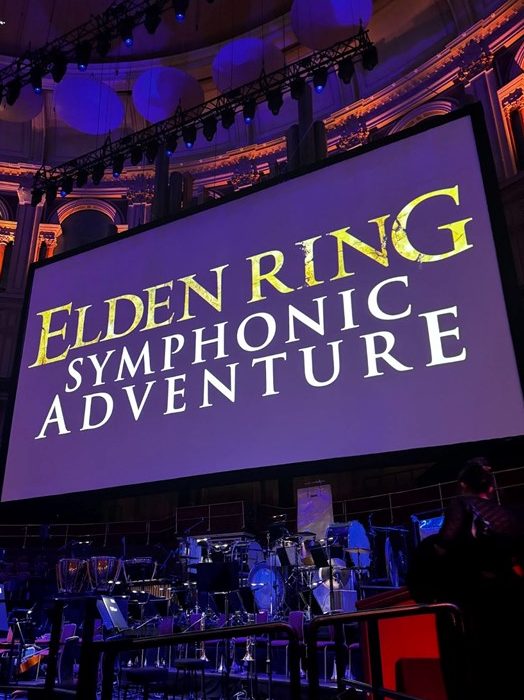
As many concert-goers have come to recognise over recent years, there are new trends emerging within live orchestral music, a wildly popular and rapidly growing example is that of the soundtrack concert. For some time now, film soundtracks have featured on concert programmes, with it becoming increasingly common to see programmes fully dedicated to entire film soundtracks, played with the accompanying on-screen movie moments. Following the success of symphonic film soundtrack concerts, the newest evolution of the live soundtrack trend centres around music from video games. These concerts have introduced many younger audiences to the world of live symphonic music, where they may never have encountered it before. Those in attendance buzz with anticipation, expecting and hoping to be transported into the nostalgic land of their favourite video game through the power of music. The concert for the Elden Ring Symphonic Soundtrack was no different, with a nearly-full Royal Albert Hall of passionate gamers.
Many video games and their soundtracks lend themselves very well to this live music setup, wildly popular role playing games such as those in the Elder Scrolls or Final Fantasy franchises feature epic orchestral and choral soundtracks with the music ranging from ambient and explorative, to dramatic and inspiring. Elden Ring’s music can be described similarly, perhaps with a darker twist, due to the general bleakness of the game’s atmosphere. The content is heavy on epic brass and rousing percussion, and promises a galvanizing atmosphere.
However, it seems that we are learning now that video game soundtrack events require a slightly different formula than film music concerts. Where in film, the soundtrack is written for specific scenes and/or made to fit with the on-screen events, never changing each time the film is played and so static and fixed in its “right place,” video game music has rather more ambiguous timing. The soundtrack may change at any given moment during exploration. For example, an ambient, pastoral sound to accompany a vast and uncharted landscape can turn to drama in an instant when triggered by an encounter with a nearby enemy.
Video game music is clever in this way, its flexibility works well within the confines of the game, supplying suitable emotional and triggers to the player sometimes without them even realising it. So where visuals are relatively easy to configure during film soundtrack concerts to match with the film’s narrative, it is much more difficult to create the same effect with game music, as each individual player’s experience of the game will be different, especially if the games are open-world and mostly free choice. Unlike in films, an individual’s narrative will always be unique, each playthrough will differ, and this is what we are still learning to translate into the live music experience.
In this specific example, the visuals appearing alongside the music from Elden Ring featured a mixture of sweeping landscapes and actual gameplay footage. Sweeping landscapes are certainly the safe option here, the only criticism one may have for this is that it can become repetitive or boring. However, including gameplay footage is another matter. Due to the individual experience of video games, these visuals can be rather distracting and the gamers in the audience will certainly be tempted to scrutinise the character design or playstyle of the phantom player controlling this footage. Gameplay footage can also be rather repetitive and appear disjointed due to often imperfect game mechanics. It was clear at this event that the audience sometimes struggled with too much stimuli to analyse, or even enjoy.
But if we cannot use gameplay footage at all, how are we supposed to pair the intense music of fight scenes with no fight visuals? One way is to abandon the effort altogether, and instead to pair these parts of the soundtrack with more imagery of the game’s environment, perhaps of the more threatening areas or landscapes. Another suggestion would be to include cutscene visuals to provide smoother imagery, however more problems arise here when there is not enough cutscene material to last an entire movement or piece, and so it becomes repetitive once again. There is also an argument for including no visuals at all during these concerts, or to include only stills from the game, to encourage the audience to be transported into the game’s environment only within themselves through recognition of each musical theme alone. However, finding an effective way to be immersed through both audio and imagery arguably makes for a better experience. Maybe with future technological development, we can find an alternative solution for a more streamlined execution of these events.
Despite the growing pains of matching the music with on-screen imagery, game soundtracks provide valid and interesting material for concert programmes. Although still a little unorthodox within the general symphonic music sphere, it is clear that these events excite an entirely new audience of young people, introducing them to the world of orchestral music through media that they already enjoy and relate to. Game soundtrack concerts are just one way in which classical and symphonic music is being refreshed by inviting those who may have previously felt alienated into the fold. At the Elden Ring Symphonic Adventure, concert-goers appeared inspired after having experienced their favourite soundtracks played by real musicians in a real space, appreciating the music’s liberation from its usual confines of a gamer’s headset. This appreciation was well deserved, as the soundtrack was adapted and executed very well, with smooth transitions between different themes and enthusiastic playing.
Similarly to film soundtracks, game soundtracks have an extraordinary ability to immerse and inspire listeners by presenting a narrative. This narrative speaks to the listener’s own experience of watching a particular film or playing a game, reminding them of the enrichment they experienced when hearing the music for the first time. For this reason, soundtrack concerts keep growing in popularity, and with experience, they continue to improve. The Elden Ring Symphonic Adventure proved to be a successful step in the right direction. With organisations such as The Game Music Foundation, responsible for The Game Music Festival, and The London Video Game Orchestra promoting the genre, video game music appears to have a very bright future within our concert halls and orchestral music spaces.


 PB Sound scapes
Leave a comment